Wallpaper in the kitchen on one wall - where to place it and which pattern to choose?
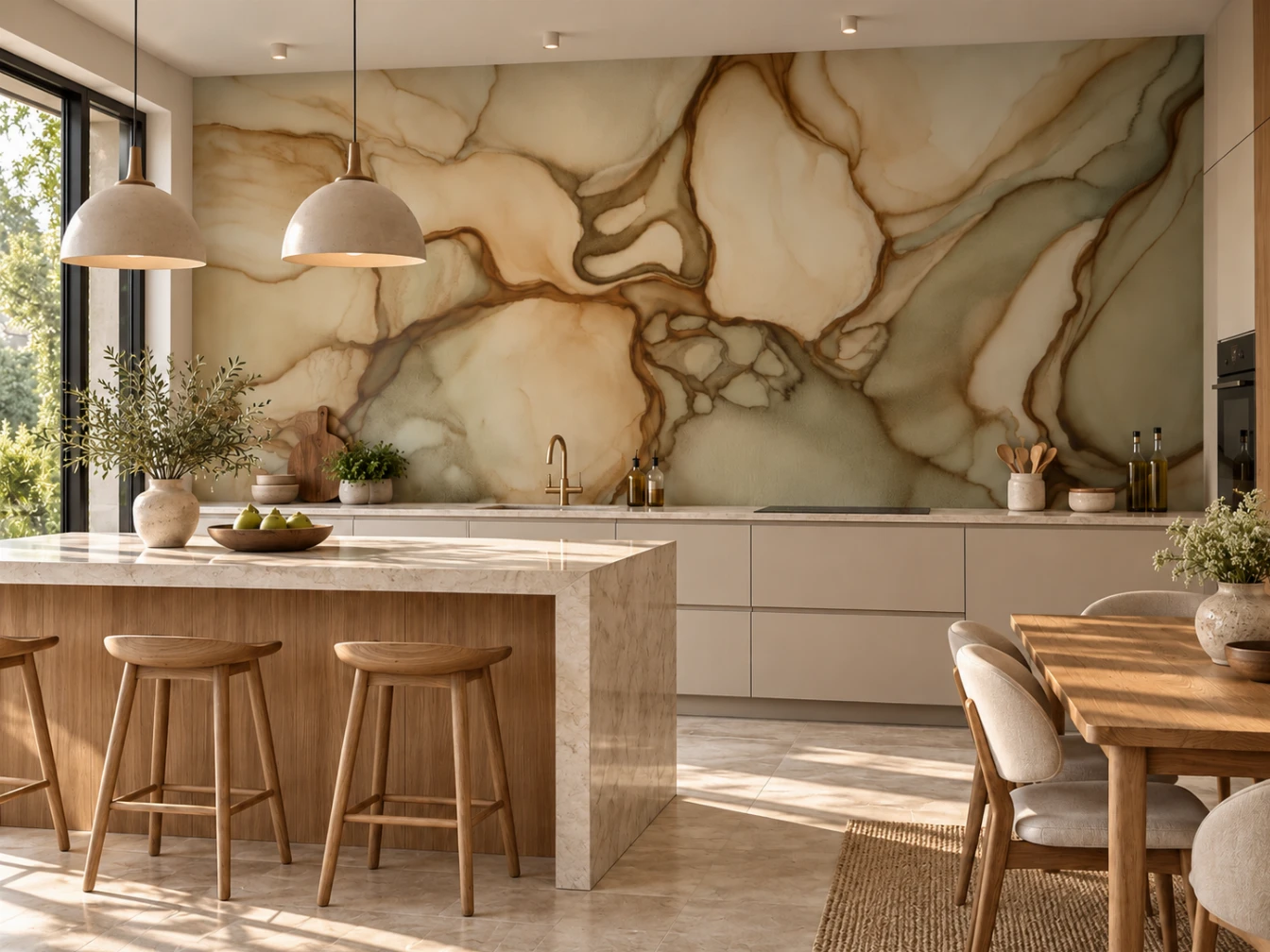
Wallpaper in the kitchen on one wall - where to place it and which pattern to choose?
Wallpaper in the kitchen on one wall can serve a very specific function: to separate the dining area from the working area, to close the cabinetry composition, or to introduce a stronger motif into the interior without decorating all the walls. However, in the kitchen, not only the graphic itself matters. Equally important is the installation location and the type of substrate, because walls here are more exposed to moisture, grease, and dirt than in the living room or bedroom.
The least problematic will be a wall away from the sink and the stove. If the mural is to be placed closer to the countertop, more attention must be paid to the material properties and the possibility of additional surface protection.
Where to place wallpaper in the kitchen?
The most freedom is given by a full wall without cabinets or appliances. A large graphic remains clear then, and its composition is not interrupted by cabinetry. This is a good place for murals with landscapes, vegetation, or more elaborate drawings.
Another natural place is the wall by the table. Wallpaper can then clearly mark the dining area, especially in a kitchen open to the living room. With a large table, patterns with a calmer center composition work well, so they do not compete with the lamp, chairs, and table decoration.
In smaller kitchens, an interesting place is also the wall by the bar or peninsula. A graphic visible from the living room side can connect both parts of the interior color-wise, instead of creating a strong boundary between them.
Wallpaper above the kitchen countertop
Wallpaper above the countertop requires more attention than a mural on a free wall. This part of the kitchen is exposed to steam, splashes, and dirt generated during cooking. Therefore, the material should be chosen for more intensive use.
Among REVE's offerings are vinyl substrates on non-woven backing. They are more resistant to daily use, abrasion, and dirt than more delicate decorative materials.
If the wall regularly comes into contact with moisture or water, the REVE mural can be additionally protected with a resin layer. This solution is worth considering especially in the kitchen, where a wall section is close to the sink or worktop.
Near the stove, it is always necessary to follow the device manufacturer's recommendations and maintain safe distances from high-temperature sources.
Wallpaper between the countertop and cabinets
A narrow strip between the countertop and upper cabinets creates a completely different effect than a mural on the entire wall. Here, it's not about a large scene or landscape, but a detail integrated into the cabinetry line.
Graphics that tolerate strong cropping work best here: abstractions, plant motifs, stone textures, soft color transitions, or patterns without a single dominant point.
With such use, the choice of substrate is especially important. The wall section above the countertop is more exposed to water and dirt than the decorative part away from the work zone.
What wallpaper for the kitchen?
In the kitchen, it's worth starting with the material and only then choosing the pattern. The visual effect matters, but it should not overshadow functional issues.
Vinyl wallpapers are most often chosen for this room because their surface handles daily use better. In the case of REVE, one graphic can be ordered on several different substrates, so the material type can be matched to the installation location.
On the wall by the table, you can allow yourself more freedom. Above the countertop, it's better to choose a substrate designed for more demanding conditions and consider additional protection.
Which wallpaper pattern for the kitchen?
The kitchen usually has more fixed elements than the living room: fronts, countertop, appliances, handles, tiles, and lighting. Therefore, the wallpaper should not introduce another random color.
With light fronts, you can use a darker or more saturated graphic. White or cream cabinetry shows greens, warm browns, earth tones, and deeper grays well.
In a kitchen with a lot of wood, patterns inspired by nature look interesting, but not necessarily literal. A blurred landscape, a fragment of vegetation, or a graphic resembling stone texture usually offers more freedom than a small, regular ornament.
With colorful fronts, it's better to look for a pattern that takes on one of the already present shades. This way, the wallpaper becomes part of the whole composition instead of acting like a separate element stuck at the end of the project.
Wallpaper in a small kitchen on one wall
A small kitchen does not have to mean giving up a large pattern. What matters more is what happens in its composition.
A graphic with a clear perspective can add depth to the wall. Delicate tonal transitions do not divide the interior into additional small fields. On the other hand, a very small, contrasting ornament can make a small space visually more restless.
If the kitchen already has many open shelves, decorations, and visible appliances, the mural can play a calmer role. With simple cabinetry, you can allow yourself a stronger graphic.
Custom mural for the kitchen
With wallpaper on one wall, framing is especially important. A ready-made pattern from a roll repeats according to a specific repeat, while a mural can be prepared for the exact width and height of the wall.
At REVE, the graphic is adjusted to the surface dimensions. This allows deciding which part of the pattern will be behind the table, how high the main motif will run, and whether an important fragment of the composition will not be hidden by furniture.
This is also important for walls with doors, niches, or cabinetry sections. Instead of randomly cutting the pattern, you can plan its placement in advance.
Wallpaper in the kitchen - the pattern is only half the decision
When choosing wallpaper for the kitchen, it's easy to focus solely on color and motif. Meanwhile, the installation location often determines which substrate will be reasonable.
On a free wall behind the table, possibilities are wide. Above the countertop, you have to think about moisture and dirt. Near the sink, it's worth considering additional mural protection.
Only after determining these conditions can you calmly proceed to choose the graphic. Then the wallpaper is not just decoration but an element planned together with the layout of the entire kitchen.
